Multi-Agent Systems to Optimize Retail Inventory
How autonomous agents can transform inventory management within the retail sector.
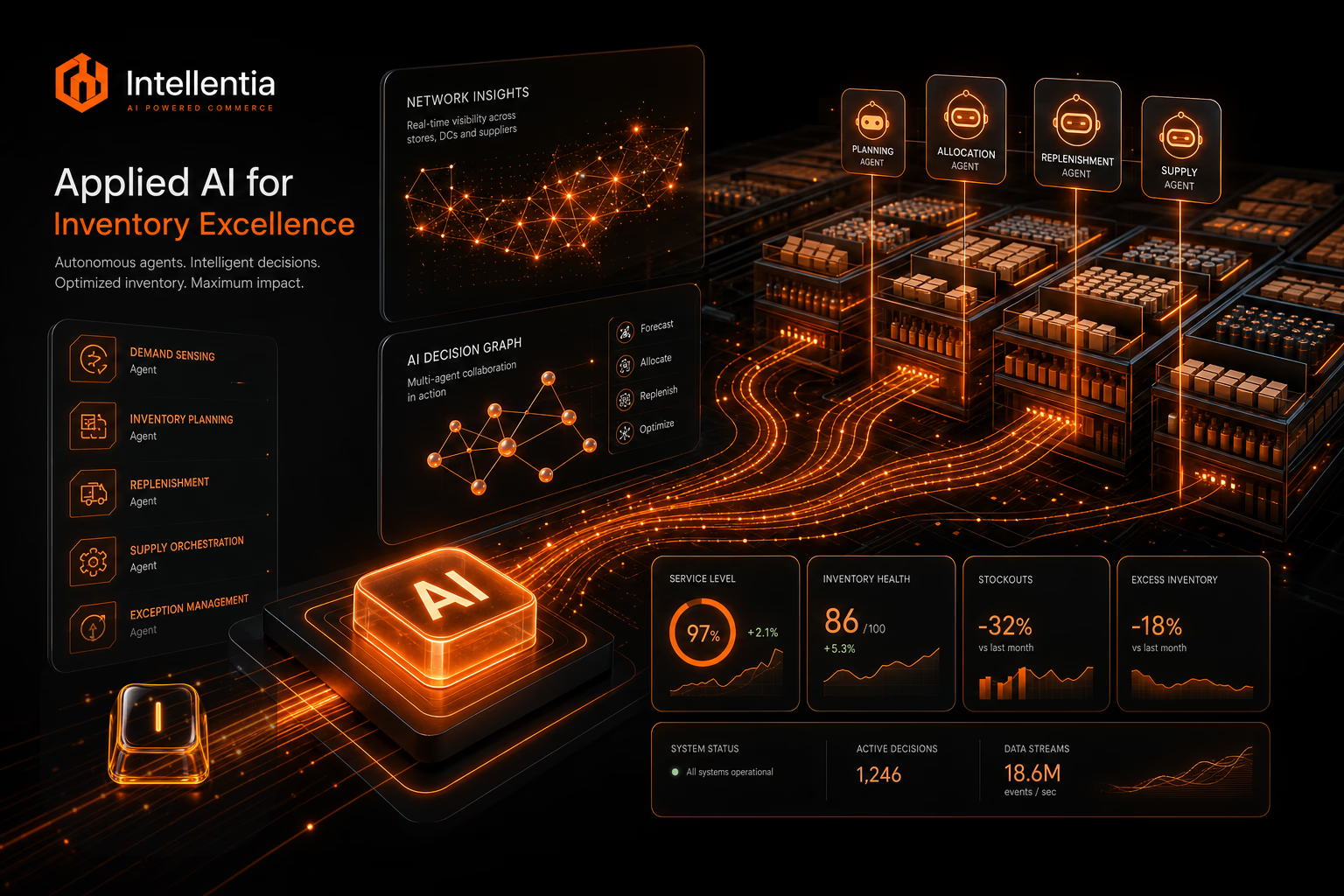
Multi-agent systems offer advanced solutions for inventory management in retail, enabling optimization even in complex operations with multiple warehouses and sales channels.
What are multi-agent systems and how do they work?
Think of a multi-agent system as a team of specialized bots. Each 'agent' is a small, autonomous program we build to handle one specific job. For a retail business, this means one agent might focus solely on forecasting demand using your sales data, another on monitoring stock levels in real-time, and a third on coordinating shipments between your warehouses. They're specialists.
The key is that these agents don't just work alone; they communicate. The sales-trend agent detects a spike in demand for a specific product and flags it. The inventory agent for Warehouse A sees this, checks its stock, and realizes it's running low. It then communicates with the supplier agent to trigger a reorder and with the logistics agent to see if Warehouse B can cover the immediate shortfall. It's a coordinated, automated system.
What inventory challenges do they solve in retail?
What we see when we build this for retail clients are the same recurring headaches: capital tied up in overstocked items nobody wants, or lost sales from stockouts on popular products. Then you add the complexity of syncing inventory across your e-commerce site and physical stores. Multi-agent systems are built to tackle exactly this kind of multi-variable problem by:
- Providing accurate demand forecasting based on historical and real-time data.
- Optimizing replenishment to avoid overstock or stockouts.
- Efficiently coordinating between warehouses to reduce transport costs.
Let's make this concrete. Imagine a customer buys the last pair of a specific shoe size online. An agent immediately updates the central inventory, making it unavailable online. Simultaneously, another agent checks if any physical stores have that shoe. If so, it can trigger a 'ship from store' process or simply update local stock levels. No more selling items you don't actually have.
What tools and technologies are used?
When we build these systems, the core logic for the agents is typically written in Python for its flexibility and robust libraries. For the predictive parts, like demand forecasting, we integrate models built with frameworks like TensorFlow or PyTorch. The most critical piece is the integration layer—we build custom APIs to ensure the agents can reliably read from and write to your existing ERP, CRM, and e-commerce platforms. The system has to talk to your stack.
This isn't something you run on a single server in the back office. We build these on cloud infrastructure, usually AWS or Azure. This gives us the ability to scale processing power up or down based on demand, like during a Black Friday sale. It also guarantees the system is always on and responsive, which is non-negotiable when it's managing your core operations in real-time.
How much time and cost does it take to implement one?
The timeline and budget depend entirely on the complexity of your operation. How many warehouses? How many sales channels? How clean is your data? For a mid-sized retailer with a few locations and an online store, a foundational system usually takes us 3 to 6 months to build, test, and deploy. The investment typically falls in the $30,000 to $100,000 range, depending on the number of custom agents and integrations required.
We always start with a deep-dive analysis phase. This isn't about creating documents; it's about mapping out your exact operational flows, defining what 'success' looks like in numbers, and designing an architecture that won't break in six months. Getting this blueprint right upfront is what prevents costly rebuilds down the line. This is where a technical team that has built these before keeps you from getting burned on a flawed foundation.
This isn't just about moving boxes more efficiently. It's about building an inventory system that actively makes you more money and stops disappointing your customers.
What does this mean for your business?
So what does this actually mean for your P&L? It means less capital wasted on stagnant stock and fewer abandoned carts due to 'out of stock' messages. It means turning your inventory from a passive cost center into a responsive, data-driven asset. This kind of system is built for businesses that want to compete on operational excellence, without needing to hire an entire in-house AI team to do it.
FAQ
Can a multi-agent system integrate with my current ERP?
What size business needs this solution?
Also on Intellentia: what we do · our solutions · real cases
Read more: official documentation on multi-agent systems · TensorFlow for predictions
Keep reading: What is AI Agent Orchestration and How to Use It · How to Automate Post-Purchase Surveys in Retail · How to Deploy an AI Agent for Managing Hospitality Bookings · How to Automate Sales Reporting in Retail Without Manual Errors · How to Automate Cancellation Management in Restaurants