How to Automate Dynamic Menus in Restaurants with AI
Dynamic menus not only improve customer experience but also optimize restaurant operations. Here's how to implement them using AI.
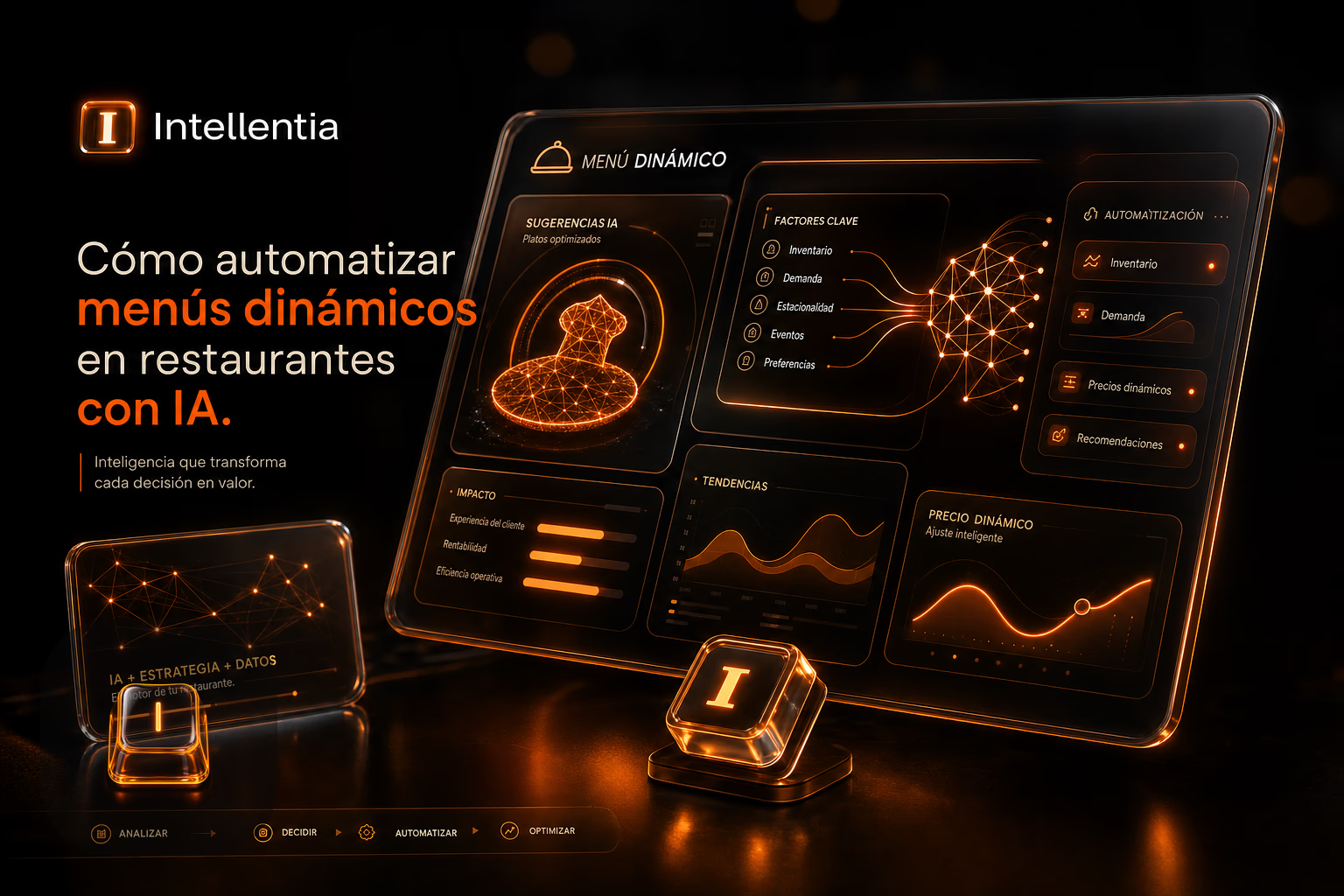
Automating dynamic menus in restaurants with AI allows real-time personalization of offerings, enhancing both customer experience and operational efficiency.
What are dynamic menus, and why do they matter?
Think of a dynamic menu as a smart system that adjusts your offerings on the fly. It connects to your inventory data, your sales history, and even external sources like the local weather forecast. So, if it's a cold, rainy day, the system automatically pushes your hearty soups to the top of the digital menu. If you're overstocked on avocados, it can feature guacamole specials to move product before it spoils. It's about making practical, data-driven decisions in real time.
Making this happen requires connecting a lot of moving parts: your POS system, inventory management, and maybe even your supplier databases. This is where the AI does the heavy lifting. It's the engine that constantly analyzes all that incoming data—sales velocity, stock levels, customer patterns—and turns it into a simple, actionable instruction: 'Promote the salmon dish now.' That's it.
How does dynamic menu automation work?
When we build a dynamic menu system, we follow a clear, structured process. It’s not magic; it’s engineering. Here’s the typical blueprint:
- Data collection: Integrating sources like sales history, inventory, customer purchasing patterns, weather, and local events.
- Data processing: Using AI algorithms to analyze and detect actionable patterns.
- Dynamic menu generation: Creating personalized and optimized menus based on processed data.
- Integration with existing systems: Connecting the solution to POS systems, delivery apps, and digital restaurant displays.
Behind the scenes, the architecture is straightforward but robust. We build a central data pipeline that pulls information from your systems via APIs. For the 'brain,' we train machine learning models, often using frameworks like TensorFlow or PyTorch, to predict demand and identify opportunities. These models then push updates to your front-end systems—digital menu boards, apps, POS terminals—through another set of APIs. We also integrate external data sources, like the OpenWeather API, to add context like local weather patterns. It's all about connecting the right data to the right decision engine.
What real benefits does this implementation offer?
This isn't just about cool tech; it's about measurable results. Here’s what happens once the system is up and running:
- Increased revenue: Personalizing offerings boosts sales likelihood.
- Reduced waste: Adjusting menus based on inventory prevents unnecessary losses.
- Enhanced customer experience: Offering relevant options improves satisfaction.
- Operational optimization: Allows staff to focus on higher-value tasks.
What we see when we build this in real businesses is that a well-tuned dynamic menu can lift revenue by up to 20%. It's a direct result of selling the right thing at the right time.
How much time and cost does it take to implement this solution?
What people ask us every week is, 'How long does this take and what does it cost?' The timeline is typically 4 to 8 weeks. The cost depends entirely on the complexity of your existing tech stack. Integrating with a modern, API-friendly POS is straightforward; connecting to a legacy, closed system requires more custom work. That's why the range is broad, but we scope every project to fit the specific operational reality of the business.
The initial investment pays for itself through reduced waste and increased sales. For any restaurant with decent foot traffic, the ROI isn't a question of 'if,' but 'how fast.' This is an operational upgrade, not just a line item expense.
What does this mean for your restaurant?
Ultimately, automating your menu with AI is about running a tighter, smarter ship. It turns guesswork into data-driven decisions that directly impact your bottom line and make customers happier. This isn't a futuristic fad; it’s a practical tool for gaining a real operational edge, built for businesses that want to use their own data to work more efficiently.
FAQ
Do I need an in-house tech team to implement this?
Does this work for all types of restaurants?
Also on Intellentia: what we do · our solutions · real cases
Read more: TensorFlow · OpenWeather API
Keep reading: How to Automate Upselling in Restaurants with AI · How to Automate Table Assignment in Restaurants with AI · How to Automate Cancellation Management in Restaurants · How to Automate Personalized Promotions in Retail with AI · How to Automate Online Review Management for Restaurants