Can AI Predict Customer Churn in Retail? Strategies for 2026
Discover how AI identifies at-risk retail customers and drives smarter retention strategies for measurable results.
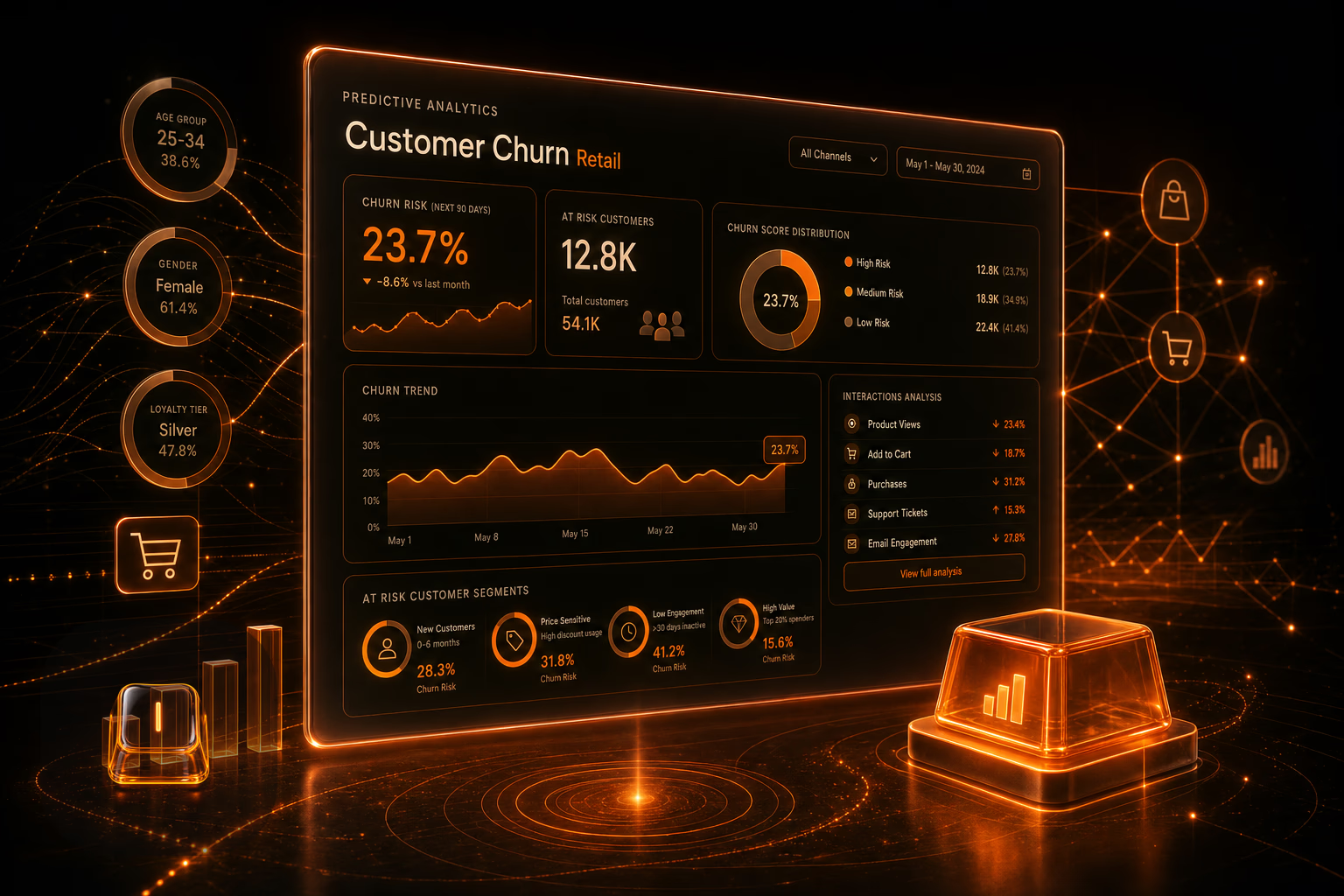
Yes, AI can predict customer churn in retail. By leveraging advanced data analytics, AI models detect patterns in customer behavior, enabling businesses to proactively retain at-risk customers.
What is customer churn and why does it matter in retail?
Churn is the metric that tracks customers walking away. For any retail business, it's a direct hit to revenue and customer lifetime value (CLV), making it one of the most critical numbers on any dashboard. The data is clear: in 2026, retaining a customer remains five to seven times cheaper than acquiring a new one. This isn't just a saying; it's a financial reality.
What people assume is that churn analysis is about looking backward to see why people left. What actually happens once you implement a predictive model is you shift from reactive to proactive. Instead of post-mortems, you get a dashboard showing who is *likely* to leave based on signals like declining purchase frequency or lower app engagement. This lets you make a decision *before* the revenue is lost.
How does AI predict customer churn in retail?
At its core, a churn prediction model is a machine learning algorithm trained on your own data. It sifts through historical and real-time signals—transactions, website clicks, customer service logs—to find the subtle patterns that precede a customer leaving. The model isn't static. It constantly refines its own logic as new data comes in, making its predictions sharper.
- Purchase patterns: Are customers buying less frequently or spending less?
- Engagement data: Have app logins, email opens, or in-store visits declined?
- Sentiment analysis: Are there increasing complaints or negative feedback?
Let's make this concrete. A model we build for a retail client might flag a customer with a 92% churn probability. This score isn't a guess; it's calculated from specific signals like 'no app login in 45 days' and 'last purchase >60 days ago'. This single metric triggers a clear business rule: automatically send a targeted re-engagement offer. No manual analysis needed. That’s the goal.
What data is required to build a churn prediction model?
A prediction model is only as good as the data it's fed. To get an accurate picture, you need to pull from multiple sources to build a unified customer view. The goal is to connect the dots between different datasets, because the most powerful signals often live where different systems meet.
- Transaction history: Purchase frequency, average order value, and product categories.
- Customer interactions: Email click-through rates, app usage, and loyalty program activity.
- Demographics: Age, gender, location, and other optional attributes.
What we see when we build this in real businesses is that the biggest hurdle isn't the AI, it's the data. Most companies have valuable information trapped in silos—the CRM doesn't talk to the e-commerce platform, and support tickets are in another system. This is where a technical team keeps you from getting burned. Our first step is always to build a clean, centralized data pipeline. Without it, any model will produce garbage predictions.
How long does it take to implement AI for churn prediction?
Building a churn model isn't an overnight project. The timeline is a function of three variables: the quality of your existing data, the complexity of the model required, and how quickly your team can integrate the outputs. For a typical retail business in 2026, we map out a clear, phased approach.
- 2-4 weeks: Data integration and cleaning.
- 4-8 weeks: Model development, training, and validation.
- 2-3 weeks: Testing, fine-tuning, and deployment.
The investment depends on the project's scope, but the business case is straightforward. For mid-sized retailers, a project typically falls in the $15,000 to $25,000 range. The key metric is ROI. A 3-5% reduction in churn isn't just a vanity metric; for a retailer with $20 million in revenue, cutting churn by just 3% means adding $600,000 back to the bottom line. The model pays for itself, fast.
For a $20M retailer, a 3% churn reduction isn't a small win. It's $600,000 in recovered revenue. That's the only metric that matters.
What are the business outcomes of churn prediction in retail?
The real output of a churn model isn't a prediction; it's a decision. Knowing a customer has an 85% chance of leaving is only useful if it triggers a specific action. This is about moving from raw data to targeted retention campaigns, smarter marketing spend, and proactive customer service. Every prediction should answer the question: 'What do we do now?'
Imagine a subscription box service. The model flags high-CLV customers who are now skipping renewals. Instead of a generic 'we miss you' email, the system can automatically trigger a tailored incentive—a free premium item in their next box or a temporary upgrade. This is data-driven retention. It's precise, automated, and far more effective than broad-stroke marketing.
| Benefit | Impact |
|---|---|
| Reduced churn | Increase retention rates by 3-5% |
| Optimized marketing spend | Focus budget on high-risk customers |
| Improved customer experience | Address dissatisfaction proactively |
| Higher revenue retention | Preserve lifetime value of key segments |
What challenges can arise when implementing AI for churn prediction?
Building a predictive model is a rigorous process, and there are known variables that can derail it if not managed properly. These aren't roadblocks, but they are critical checkpoints:
- Data quality: Incomplete or inconsistent data can reduce model accuracy.
- Integration: Synchronizing data across CRM, e-commerce, and loyalty systems.
- Interpretability: Ensuring non-technical teams can understand and act on AI insights.
This is exactly why it pays to implement it properly. We mitigate these risks by starting with a focused pilot. This isn't just a 'test run'; it's a controlled experiment to validate the model's accuracy on a subset of data, fine-tune the operational workflow, and establish a clear baseline for ROI before a full-scale rollout.
How can retailers get started with AI churn prediction?
For any retailer ready to move from reactive to predictive analytics, the process follows a logical sequence:
- Audit your data: Assess data quality and identify gaps.
- Define your goals: Determine the key metrics you want to improve, such as churn rate or customer lifetime value.
- Choose the right tools: Select AI platforms and vendors with proven experience in retail.
- Start small: Run a pilot project to validate the model and refine processes.
- Scale strategically: Expand the solution across your customer base after initial success.
In 2026, using predictive models for churn isn't just an option; it's a core component of a data-driven retail strategy. It's built for businesses that want to make smarter decisions without needing an in-house data science team. The end goal is simple: reduce churn, protect revenue, and use data to build a more resilient business.
FAQ
Can AI really predict customer churn?
What industries benefit most from churn prediction?
What tools are needed to implement AI for churn prediction?
Also on Intellentia: AI technology we use · AI-powered solutions · case studies
Read more: Customer Retention Trends 2026 · AI in Retail Statistics · Predictive Analytics in Retail
Keep reading: Using AI to Detect Fraud in Retail Transactions · Using AI to Forecast Demand in Restaurants · Using Prediction Models to Optimize Pricing in Retail · From Data to Decision: Using Real-Time Dashboards Effectively · Using Predictive Analytics for Inventory Planning